 Zum Inhalt springen


Abstrakt
For apparel manufacturers and fabric sourcing teams, choosing between Sherpa Vlies and Polar Fleece is more than a material selection — it directly influences product performance, market positioning, production costs, and end-user experience. Although both fabrics are polyester-based and widely applied in jackets and outerwear, their fiber construction, surface characteristics, thermal behavior, and commercial value differ significantly.
This article provides a technical and commercial comparison of Sherpa Fleece fabric and Polar Fleece across five key areas: fabric construction, insulation and durability performance, compliance requirements, sourcing considerations, and application suitability. The goal is to help B2B buyers, including product developers, procurement managers, and private-label brands, evaluate whether Sherpa Fleece can replace Polar Fleece in specific outerwear projects or whether combining both materials offers a more effective product strategy.
1. Understanding the Two Fabrics: Construction & Core Properties
1.1 What Is Sherpa Fleece Fabric?
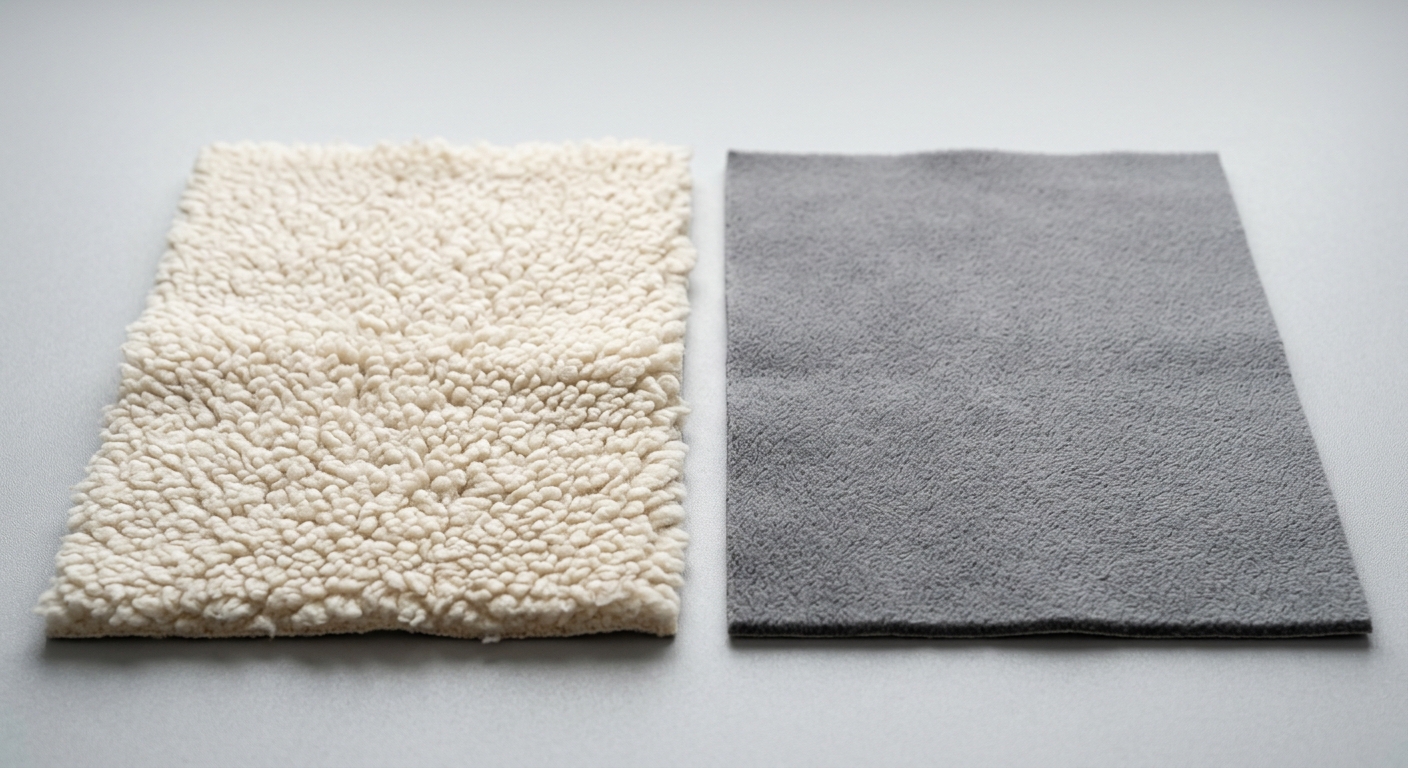
Sherpa Fleece is a knitted fabric designed to reproduce the soft, warm, and textured feel of natural sheepskin or wool while maintaining the durability and cost advantages of synthetic fibers. Its signature feature is a high-loft curly or nubby pile surface on one side, combined with a smooth jersey or ribbed knit backing on the reverse. This two-sided construction creates functional versatility: the pile surface provides warmth, softness, and a premium visual appearance, while the flat back offers excellent bonding performance with woven shells in laminated or bonded outerwear applications.
Sherpa Fleece fabric is commonly produced with 100% polyester or polyester-acrylic blends, with GSM (grams per square meter) typically ranging from 220 GSM to 420 GSM depending on pile density, thickness requirements, and final application. Heavier constructions (350–420 GSM) are commonly selected for standalone jackets, winter coats, and high-warmth outerwear, while lighter weights are suitable for inner linings, collar panels, and garment details. Compared with standard fleece materials, Sherpa Fleece is especially valued in lifestyle and fashion-oriented outerwear because its wool-like appearance creates a premium product impression without the higher cost and maintenance requirements of natural wool.
1.2 What Is Polar Fleece Fabric?
Polar Fleece is a synthetic knitted fabric developed through a brushing and napping process, typically using a circular-knit polyester base that is mechanically raised and sheared to create a smooth, uniform pile surface. Unlike the textured appearance of Sherpa Fleece, Polar Fleece features a consistent fiber arrangement that delivers stable insulation performance, reliable abrasion resistance, and predictable behavior throughout repeated washing cycles.
Standard Polar Fleece fabric is typically made from 100% polyester, with GSM ranges commonly between 150 GSM and 320 GSM depending on the required warmth level and end-use category. Anti-pill finishes are frequently applied during finishing to improve surface durability and maintain appearance over extended use. Due to its lightweight structure, consistent quality, and easy processing characteristics, Polar Fleece remains widely used in performance sportswear, corporate uniforms, outdoor mid-layer garments, and large-volume apparel programs where durability, cost efficiency, and production stability are key considerations.
Sherpa Fleece vs. Polar Fleece — Core Specifications
| Spezifikation | Sherpa Vlies | Polarfleece |
|---|---|---|
| Fasergehalt | 100% Polyester / Polyester-Acrylic | 100% Polyester |
| GSM-Bereich | 220 – 420 GSM | 150 – 320 GSM |
| Pile Structure | High-loft, curly/nubby, irregular | Uniform, sheared, smooth |
| Surface Texture | Wool-like, tactile, dimensional | Even, soft, consistent |
| Moisture Wicking | Mäßig | Good (especially in lighter weights) |
| Pilling-Widerstand | Moderate (anti-pill finishes available) | High (standard anti-pill treatment) |
| Bonding Compatibility | Excellent (flat back) | Gut |
| Typical MOQ | 300 – 500 meters | 200 – 500 meters |
2. Performance Comparison for Jackets and Outerwear
2.1 Thermal Insulation & Weight-to-Warmth Ratio
Sherpa Fleece’s high-loft pile structure creates a deeper air-trapping layer compared with the closely sheared surface of Polar Fleece. This trapped air improves static thermal insulation in calm and dry environments, making Sherpa Fleece well-suited for lifestyle jackets, insulated coat linings, and urban winter outerwear where wind protection is provided by an external shell fabric.
However, when evaluating warmth-to-weight efficiency, the performance difference becomes more application-dependent. Polar Fleece, especially in mid-weight constructions ranging from 200–280 GSM, can achieve competitive thermal retention while maintaining a lighter overall fabric weight. For performance-oriented outerwear where garment weight, packability, and layering flexibility are critical design factors — such as travel jackets, outdoor mid-layers, and lightweight insulation systems — Polar Fleece maintains a practical advantage. Sherpa Fleece provides its strongest thermal value in heavier, fashion-focused outerwear where increased volume, texture, and visual impact contribute to the product’s commercial positioning.
For bonded outerwear applications, where Sherpa Fleece is laminated with woven shell fabrics, its deeper pile height can contribute to improved overall garment insulation performance. This advantage is particularly noticeable in moderate cold-weather conditions, typically around -5°C to 10°C, when tactile warmth and comfort are key purchasing factors.
2.2 Durability, Pilling, and Wash Performance
Polar Fleece’s tightly controlled sheared surface structure provides a measurable advantage in abrasion resistance, typically achieving 3.5–4.5 ratings on the Martindale scale under standard outerwear testing conditions. Its commonly applied anti-pill finishing also helps maintain surface appearance through repeated washing, making Polar Fleece a preferred choice for workwear, uniforms, outdoor layering systems, and other high-use garment programs.
Sherpa Fleece, in comparison, requires more careful consideration when exposed to continuous abrasion, compression, or high-temperature laundering. Due to its raised pile structure, potential issues such as matting, pile flattening, and early-stage fiber shedding should be considered during product development and care instruction planning. However, premium Sherpa Fleece fabrics with enhanced pile anchoring technology and anti-shed finishing have significantly improved durability, maintaining a stable loft appearance through repeated domestic washing when proper care conditions are followed.
3. Compliance, Certifications & Sourcing Considerations
3.1 Relevant Standards and Eco-Certifications
Both Sherpa Fleece and Polar Fleece fabrics can meet major textile certification requirements commonly requested for outerwear sourcing programs:
- OEKO-TEX STANDARD 100: Verifies that fabrics have been tested for harmful substances, including restricted chemicals, heavy metals, and other potentially harmful materials. This certification is particularly important for brands supplying EU, North American, and Japanese markets.
- Global Recycled Standard (GRS): Both Sherpa Fleece and Polar Fleece can incorporate recycled polyester (rPET) content and achieve GRS certification, supporting sustainability claims for outdoor apparel, fashion collections, and environmentally focused product lines.
- REACH Compliance: Required for textile products entering the European market, covering restrictions on chemical substances used in fibers, dyes, and finishing processes. Suppliers should provide relevant compliance documentation before bulk production.
When sourcing Sherpa Fleece specifically, buyers should evaluate not only standard certifications but also fiber composition reports and pile anchoring test data. This is particularly important for polyester-acrylic blends, where additional verification may be required to confirm chemical compliance and material consistency.
3.2 Cost Structure and MOQ for B2B Procurement
From a sourcing perspective, Sherpa Fleece typically carries a 15–35% price premium compared with comparable-weight Polar Fleece. The higher cost is mainly driven by increased raw material consumption, more complex knitting and finishing processes, higher pile requirements, and lower production volumes compared with widely available commodity Polar Fleece.
| Procurement Factor | Sherpa Vlies | Polarfleece |
|---|---|---|
| Price Range (FOB) | USD 3.50 – 7.00 / meter | USD 1.80 – 4.50 / meter |
| Typical MOQ | 300 – 500 meters per colorway | 200 – 500 meters per colorway |
| Vorlaufzeit | 25 – 40 days | 15 – 30 days |
| Supplier Availability | Mäßig | Hoch |
| Color Customization | Available, longer lead time | Readily available |
For high-volume programs, Polar Fleece’s broader supplier base and shorter lead times offer meaningful supply chain flexibility. Sherpa Fleece sourcing requires more planning, particularly for custom colorways and heavier GSM constructions.
4. Application Scenarios: When to Choose Sherpa Over Polar Fleece
4.1 Recommended Use Cases for Sherpa Fleece in Outerwear
Sherpa Fleece creates the strongest commercial value in outerwear applications where warmth, tactile comfort, and visual differentiation are key product considerations. Its distinctive pile surface and versatile backing structure make it suitable for the following categories:
- Jacket and coat linings: The flat-back construction of Sherpa Fleece bonds effectively with woven shell fabrics, adding insulation, softness, and a premium visual effect to exposed lining areas such as collars, cuffs, and interior panels.
- Fashion-forward lifestyle jackets: With its wool-like appearance and high-loft texture, Sherpa Fleece supports premium product positioning in casual and fashion-oriented outerwear. It is particularly effective for reversible jackets, where the Sherpa side becomes a visible design element rather than only a functional lining layer.
- Collar, hood, and trim applications: Even when Polar Fleece is used as the primary fabric, Sherpa Fleece is often selected for accent areas such as hood interiors, collar panels, and decorative trims. This combination allows brands to balance performance, comfort, and visual appeal within a single garment design.
- Lifestyle and urban outerwear: For brands targeting casual wear, fashion-outdoor crossover collections, and premium everyday jackets, Sherpa Fleece provides a differentiated material story that helps products stand out in competitive retail markets.
4.2 Scenarios Where Polar Fleece Remains the Preferred Choice
While Sherpa Fleece offers strong advantages in fashion-oriented applications, Polar Fleece remains the preferred option for performance-driven and cost-sensitive outerwear categories where lightweight construction, durability, and production efficiency are priorities.
- Technical mid-layer systems: For outdoor layering systems requiring moisture management, reduced garment weight, and easy movement, Polar Fleece’s consistent pile structure and reliable thermal performance make it a more practical choice than heavier Sherpa constructions.
- High-abrasion outerwear: Work jackets, hiking garments, and outdoor equipment exposed to repeated friction benefit from Polar Fleece’s tighter surface structure, stronger abrasion resistance, and more stable appearance after extended use.
- Budget-sensitive sportswear and uniform programs: Lower material costs, shorter production lead times, and wider supplier availability make Polar Fleece a preferred solution for large-volume apparel programs where cost control and supply chain flexibility are critical.
- Embroidered or printed outerwear: The smooth and uniform surface of Polar Fleece provides better compatibility with embroidery, printing, and other decorative processes, reducing the risk of surface distortion compared with higher-pile fleece fabrics.
FAQ
1. Is Sherpa Fleece warmer than Polar Fleece for winter jacket production?
In heavier GSM constructions (350 GSM+), Sherpa Fleece’s deeper pile loft provides superior static insulation. However, for comparable weights, the difference is marginal. Sherpa’s thermal advantage is most relevant in bonded outerwear or standalone coat applications — not in lightweight layering systems where Polar Fleece is more efficient.
2. Can Sherpa Fleece meet the same abrasion and durability standards required for outerwear?
Standard Sherpa Fleece underperforms Polar Fleece on abrasion resistance. However, premium-grade Sherpa constructions with pile-lock finishing can meet acceptable outerwear durability thresholds for lifestyle and fashion applications. For technical or workwear outerwear, Polar Fleece remains the more reliable specification.
3. What is the typical price difference between Sherpa Fleece and Polar Fleece at bulk order volumes?
At bulk volumes (1,000+ meters), Sherpa Fleece typically costs 15–35% more per meter than equivalent-weight Polar Fleece. This premium reflects higher knitting complexity and lower commodity production volume. For programs where Sherpa’s aesthetic enables higher retail price points, the cost differential is commercially justified.
4. Can Sherpa Fleece be used for sustainable outerwear collections?
Yes. Sherpa Fleece can support sustainable collections when produced with recycled polyester and certified under standards such as GRS. It provides a wool-like appearance while reducing dependence on animal fibers and supporting responsible sourcing strategies.
5. Which fabric is better for lightweight jackets, Sherpa Fleece or Polar Fleece?
For lightweight jackets and layering systems, Polar Fleece is usually more suitable due to its lower weight, efficient insulation, and better moisture management. Sherpa Fleece is preferred when softness, visual texture, and premium appearance are higher priorities.
6. What specifications should buyers check before sourcing Sherpa Fleece fabric?
Buyers should evaluate GSM, fiber composition, pile density, anti-shedding performance, shrinkage rate, certifications, and supplier testing reports. These factors directly influence warmth, durability, appearance retention, and long-term product performance.
Schlussfolgerung
Sherpa Fleece can replace Polar Fleece in specific outerwear applications, but it is not a universal substitute. For lifestyle jackets, bonded linings, reversible designs, and fashion-focused products, Sherpa Fleece delivers a premium wool-like appearance, enhanced warmth, and added retail value.
For technical outerwear, high-abrasion applications, and cost-sensitive programs, Polar Fleece remains the preferred choice due to its durability, lighter weight, lower cost, and supply flexibility. Many successful outerwear collections adopt a hybrid approach — using Polar Fleece for performance-focused areas and Sherpa Fleece for visible, comfort-driven, and fashion-oriented components.
For buyers, selecting the right fabric should depend on end-use requirements, product positioning, and performance expectations. If you are developing jackets, linings, or lifestyle outerwear collections, request Sherpa Fleece samples and technical specifications from qualified suppliers to evaluate GSM, pile performance, durability, and customization options before bulk production.